By Gail Barlow, HVAC Guides Editor · Updated September 2026
Before hurricane season in New Orleans, have the AC serviced, confirm the outdoor unit is secure on its pad or stand, and consider surge protection. When a storm approaches, switch the system off at the breaker. After the storm, do not restart it if water reached the outdoor unit or the air handler; have it inspected first.
Before the season: the service visit
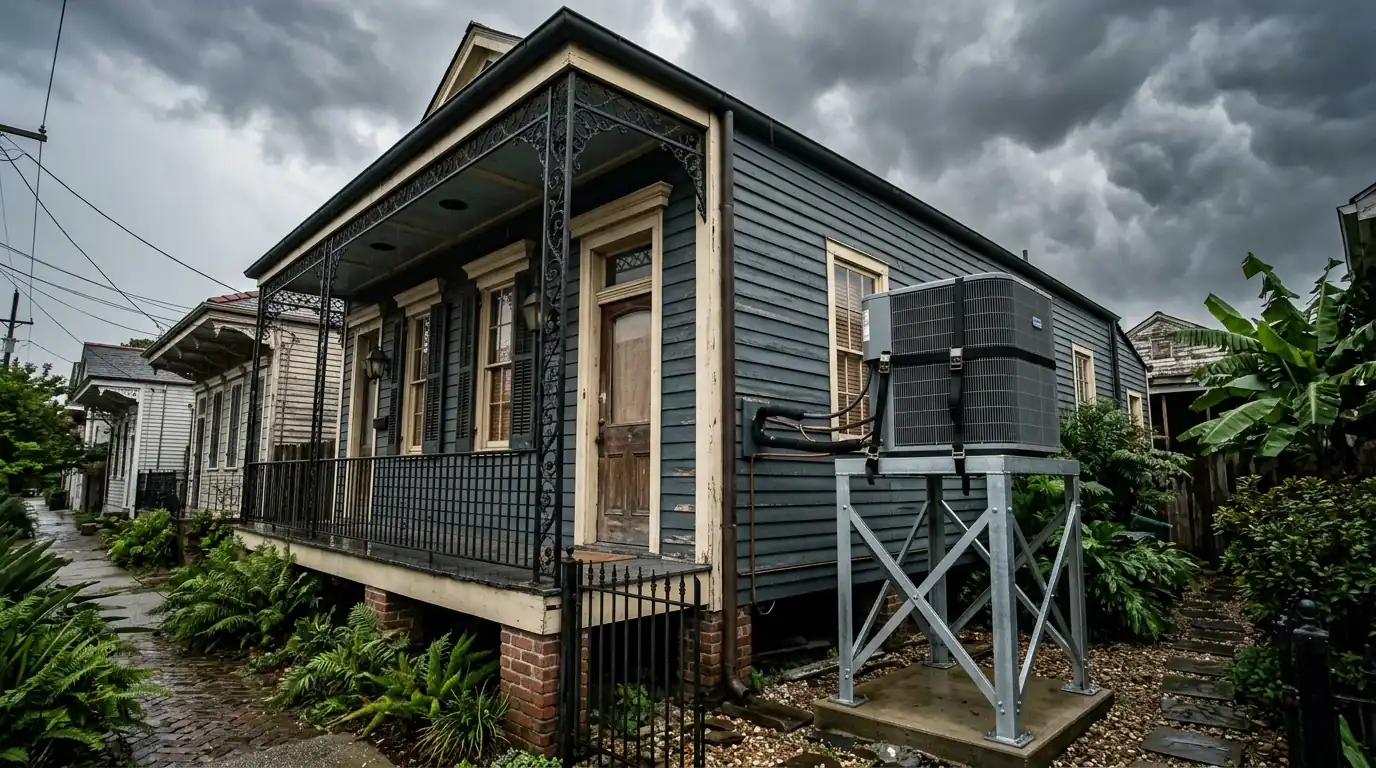
The best time to prepare is late spring, before the first named storm. A tune-up catches the weak capacitor or clogged drain that would otherwise fail during the first long, hot outage recovery, when every company in the metro is booked. Ask the technician to check that the condensate line drains away from the house and that the unit is fastened to its pad or stand.
If your unit sits on the ground in a low spot, ask about elevation now. Raising a condenser onto a stand is a planned job in May; after a flood it becomes part of an insurance claim and a long wait.
Surge protection
Power surges when the grid drops and comes back can take out control boards, capacitors and thermostats while the rest of the system is fine. A surge protector at the outdoor disconnect is inexpensive and reduces that risk. It is not a guarantee, but it turns many surge events from a repair into a non-event.
Generators and your AC
Many homeowners want to run the AC on a generator after a storm. A typical three-ton compressor draws roughly 3,500 to 5,000 watts just to start, which trips most portable generators. A soft-start kit reduces that starting surge substantially and is often what makes running a central system on a generator possible. Have the sizing checked before the season, not during an outage.
Never connect a generator to the house wiring without a proper transfer switch or interlock. Backfeeding the grid endangers line workers and can damage your equipment when power returns.
When a storm is coming
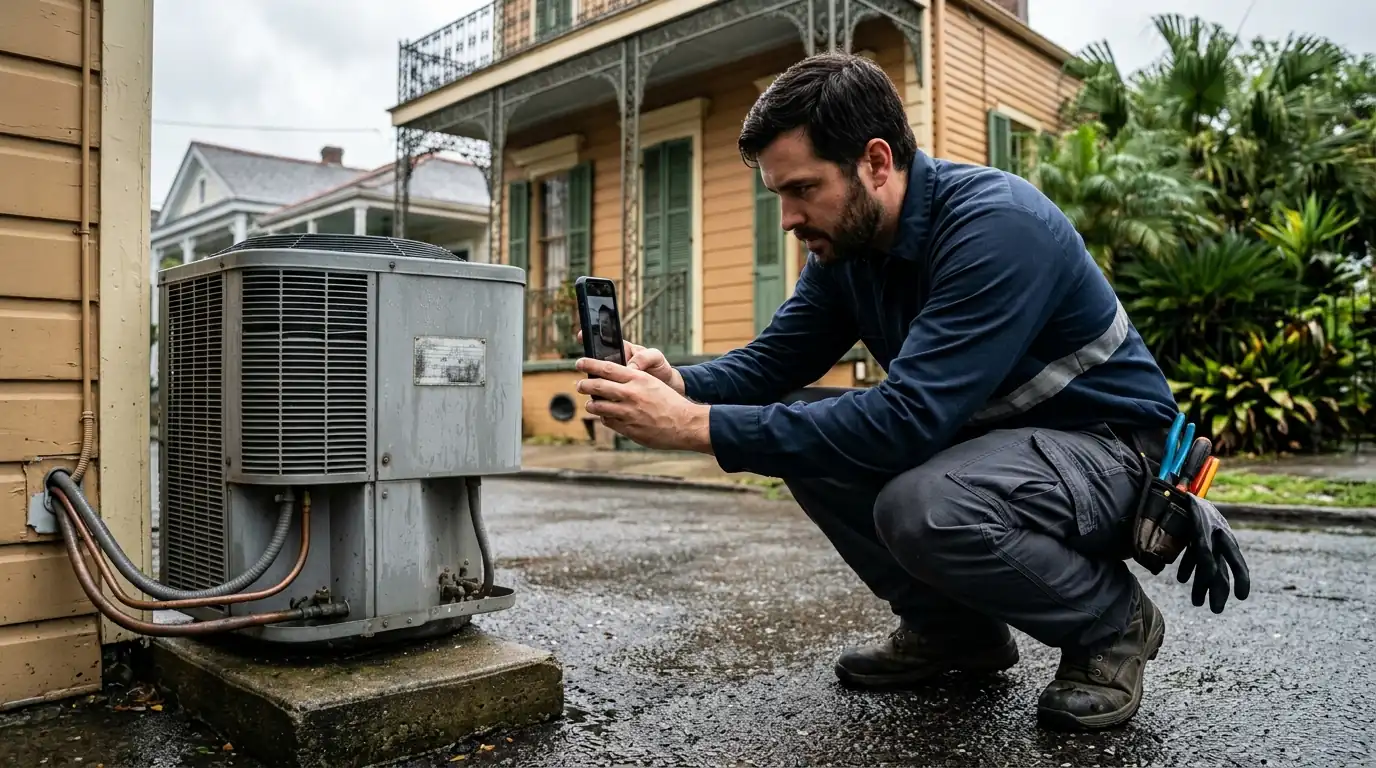
Once a storm is close, switch the AC off at the breaker and the outdoor disconnect. That protects it from surges and from starting while debris is flying. Bring in or tie down anything loose near the outdoor unit. Do not cover the unit with plastic or a tarp for an extended period; it traps moisture and invites corrosion. Take a photo of the unit and its nameplate for insurance records.
After the storm: do not rush the restart
If no water reached the outdoor unit or the air handler, and nothing is visibly damaged, it is usually safe to restore power and turn the system on once the grid is stable. Wait a few minutes after power returns before switching the breaker back on.
If water reached either unit, leave the breaker off. A flooded condenser can short its controls or seize the compressor when powered, and replacing a ground-level unit after a flood may trigger elevation requirements. On historic properties, the preservation review applies to any new equipment location too.
Photograph the water line on the cabinet before anything is moved. It is the single most useful thing you can give an insurance adjuster.

Storm hit and the AC is off? Call before you restart it.
(504) 520-4214What an inspection looks for
A post-storm inspection tests the electrical components and the compressor windings before power is applied, checks the coil for silt and debris, confirms the unit is level and secure, and inspects the drain and the indoor unit for water damage. The technician should give you a written summary with photos and model numbers you can attach to a claim, and should tell you honestly whether the unit can be dried and restarted or should be replaced.
Flooded ductwork and air handlers
Floodwater does not stop at the outdoor unit. In raised homes with ducts or an air handler in the crawl space, and in slab homes where water came inside, the indoor side can be damaged too. Duct insulation that has been soaked holds moisture and can grow mold even after the water recedes, and flex duct that sat in floodwater is generally replaced rather than cleaned.
An air handler whose blower motor or control board went under water needs the same caution as a flooded condenser: no power until it has been inspected. If the air handler sits in an attic and only the outdoor unit flooded, the indoor side is usually fine, and the repair or replacement is limited to the condenser.
When you document the damage, include the indoor side: the water line in the crawl space or closet, wet duct insulation, and the air handler nameplate. Adjusters see a lot of claims after a storm, and a clear record of both sides of the system saves time.
Checklist to keep
- Spring: tune-up, drain check, confirm the unit is secured.
- Before a storm: breaker off, loose items secured, photos taken.
- After the storm: check for water on either unit before restoring power.
- If water reached it: keep the breaker off and call for an inspection.
Questions readers ask about this
Yes. Switch it off at the breaker and the outdoor disconnect once the storm is close.
Not for long. A tarp traps moisture. Secure loose items nearby instead.
Often, with a large enough generator and usually a soft-start kit. Have the sizing checked first.
Not always. Rainwater at the base can sometimes be dried out; brackish or deep water usually means replacement.
It depends on your policy; flood coverage is often separate. Good photos and a written report help.
Related guides and services
R-22 systems: repair or replace
An older AC that runs on R-22 gets costly to fix once it leaks. How to tell if yours uses R-22 and when a.
R-22 systems: repair or replaceHVAC checklist for rentals
Between tenants, through the season and when something breaks: an HVAC checklist for rental homes, apartments.
Read: HVAC checklist for rentalsSEER2 rules in Louisiana
What the SEER2 minimums mean for a new AC or heat pump in Louisiana, why matched systems matter, and what to.
SEER2 Rules for AC Replacement in LouisianaPost-Storm HVAC Inspection & Restart
Flooded condenser check, power surge damage and more.
More on Post-Storm HVAC Inspection & RestartAC Installation & Replacement
Condenser-only replacement, matched system replacement and more.
AC Installation & Replacement from our team